The People Who Find It Easiest To Build An Online Course Are Rarely The Ones With The Most To Teach.
If you have spent years becoming genuinely good at something, starting an online course will probably feel harder than it should. That is not a coincidence. And it is not a flaw in you.
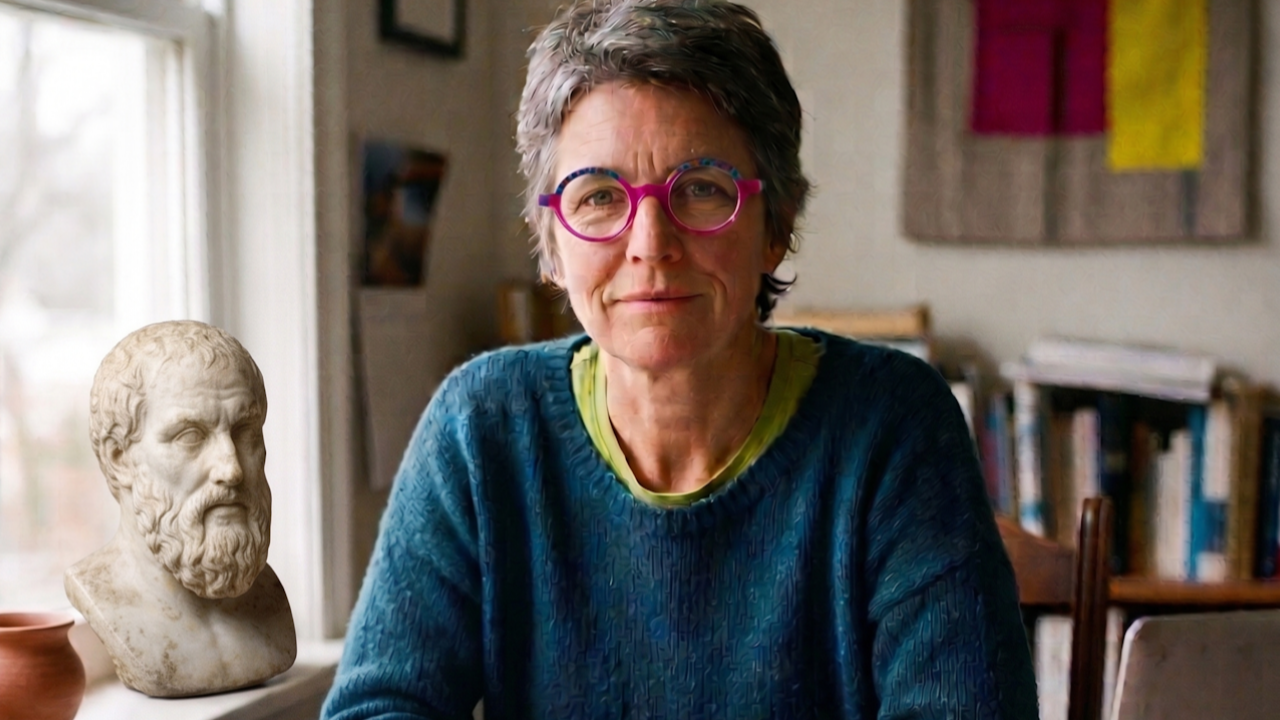
I want to tell you about a woman called Iona.
I met her at the British Museum, at one of those private evening events where everyone seems to know each other, and the conversation is already three steps ahead of you before you have even picked up a drink. Iona was a senior curator in the Greek and Roman antiquities department, and she had spent the better part of twenty-five years with objects that most visitors walked past without a second glance. There was something about her that you notice in people who have given a long time to one deep thing, a kind of unhurried certainty, completely uninterested in impressing anyone.
At some point in the evening, a small group of us drifted towards a case of Roman ceramic lamps, and Iona started talking about them almost without meaning to. What the clay told you about where they came from. How the wear on the nozzle revealed whether a lamp had been used for work or for something more ceremonial. She wasn't showing off; she was just thinking out loud. But the rest of us had stopped talking entirely.
Afterwards, I asked whether she had ever considered teaching any of this outside the institution. Online, perhaps. She looked at me with genuine puzzlement.
"Teach what, though? It's just looking. You look at enough of them, and eventually you know."
But of course, it wasn't just looking. It was twenty-five years of looking, layered over thousands of hours in storage rooms and auction houses and on excavation sites, and a quality of attention that takes a very long time and a very particular kind of dedication to develop. There was a lifetime of teachable knowledge in that single conversation. Iona simply could not see it because to her it was not knowledge. It was just how she experienced the world.
I have thought about her often since that evening, because what happened to Iona happens in some form to almost every expert I have ever worked with. And it is, without question, the most common reason why the people with the most to offer are always the last ones to start.
What Expertise Actually Does To You
There is actually a name for what happened to Iona, and for what is very likely happening to you. Psychologists call it the curse of knowledge — a cognitive bias where people with deep expertise find it increasingly difficult to imagine what it feels like not to know what they know. It was first documented by Camerer, Loewenstein, and Weber in their 1989 paper in the Journal of Political Economy, and the finding was striking: even when it was in their direct interest to think like a less-informed person, experts simply could not do so. The knowledge had become too automatic and invisible. Too much a part of how they saw everything.
The longer you spend doing something, the more natural it becomes until eventually you stop noticing the effort at all. What used to take real thought just happens automatically, and what you once found genuinely difficult starts to feel so obvious that it barely seems worth mentioning to anyone else.
And alongside that, your eye quietly sharpens in ways you probably haven't even registered. You start to catch things that other people walk straight past, the shortcuts that cause problems further down the line, the questions that sound simple but have complicated answers, the moments where the standard advice would actually lead someone astray. You have seen enough, and done enough, to know where things tend to go wrong, even when you can't always articulate exactly why.
All of that is enormously valuable, and it is precisely why people come to you and trust what you say.
But here is where it gets a little complicated. The moment you sit down to build a course, that same hard-won awareness starts to work against you rather than for you. Suddenly, you are very conscious of everything you might leave out, every nuance you might flatten, every place where a learner could take what you've taught them and apply it just slightly wrong. You can see the gaps before they even exist, which means you keep going back to fill them, adding to the structure, softening the edges, covering your bases, waiting until the whole thing feels thorough enough to actually share.
And while you are doing that, someone with a fraction of your experience has already built something imperfect, put it out into the world, and started teaching real people in real time. They didn't know enough to worry about getting it wrong. You, with everything you know, can't quite stop.
The Standards Are The Wrong Standards.
Something that takes most people a while to realise is that the standards they are holding their course to are not course standards at all. They are the standards of their profession, the bar they have spent years working to meet, and that they now apply to everything without really thinking about it. But an online course is not a professional benchmark. It is not trying to be a textbook, or a formal qualification, or a substitute for years of lived experience. It just needs to take someone from where they are now to somewhere genuinely better than where they started. That is the whole job. Not a perfect, comprehensive, every-angle-covered masterpiece. Just something that moves people forward.
And the people who will come to your course are not your colleagues or your peers. They are not going to measure it against the highest standards of your industry, because they do not yet know what those standards are. They are simply people standing right at the beginning of something that you mastered a long time ago, looking for someone to help them find their feet.
"What feels to you like a simplified version of your expertise feels to them like a revelation."
Your instinct to protect people from oversimplification is, at heart, a good instinct. But it is being applied to the wrong situation. The people who need your course are not harmed by a version of your knowledge that does not contain every nuance you have ever encountered. They are helped by it.
Why Everyone's Advice Sounds Right But Lands Wrong
Once you start looking into building an online course, you will quickly discover that the internet is full of people telling you exactly what to do. Frameworks, blueprints, six-step systems, and done-for-you templates are all presented with complete confidence, and many of them flatly contradict each other.
Some of it really did work for that particular person, in their niche, at a specific moment, with the audience they had spent years building. The problem is that none of those details is yours. Their market is not your market. Their ease in front of a camera may be nothing like yours. The email list they launched might have been ten times the size of anything you currently have.
So you follow the steps as carefully as you can, and you end up somewhere they did not describe, wondering what you got wrong. The honest answer is probably nothing. The advice just was not built for your situation, and no amount of careful execution was going to change that.
There is something else worth noting, too: most advice focuses almost entirely on tactics and tools. What it cannot give you is the judgment that only comes from going through it yourself, the instinct for your own audience, the feel for where your expertise sits in the market. That kind of understanding cannot be handed to you. It has to be built, and the only way to build it is to start.
The Version Of This That Nobody Talks About
Most people who are stuck at the starting line are not stuck because they lack knowledge, ideas, or time. They are stuck because not having a clear path feels like a sign that something is missing, that there must be a right answer out there somewhere, and once they find it, they will be ready to begin.
But there is no right answer waiting to be found. There is just the version you build by making a decision, seeing what happens, and adjusting as you go.
That is not a comfortable thing to sit with, especially if you have spent your career in a field where the standards are clear and the milestones are recognised. Being uncertain about something, being a genuine beginner at the mechanics of it, even when you are deeply experienced in the content, feels deeply unfamiliar. And that discomfort is real.
But not having a clear path is not a sign that you are not ready. It is just what this particular thing feels like for everyone, at the beginning. Every single person who has successfully built a course and put their expertise out into the world has felt exactly what you are feeling now. The difference between them and everyone still waiting is simply that they decided to move anyway.
What You Actually Have
Here is something worth knowing. The global online learning industry is worth $204 billion and is built almost entirely on one idea: that people will pay to learn from someone who genuinely knows their subject. The demand for real expertise, taught well, is not the problem. It has never been the problem.
You already have the hardest thing to find. Years of real experience. Knowledge that took a long time to build and that other people would genuinely benefit from. That is not a small thing; that is the whole point of any course worth taking.
The rest of it, the platform, the structure, how to put it together and get it out into the world, is all completely learnable. You do not need to have figured any of that out yet. You just need some good guidance and a willingness to make a few decisions before you feel entirely certain, which, if we are being honest, is how most worthwhile things get done.
What you cannot learn quickly is what you already have sitting inside you. The depth of understanding of the real-world perspective. The hard-won knowledge that only comes from actually doing something for years.
Your expertise is not what is standing in your way. It has just spent a while convincing you that the bar is higher than it actually is. The question now is not whether you know enough. You do. The question is simply whether you are ready to start.
How We Can Help
At The Customer's Shoes, we work with people who have genuine expertise in their field and help them turn it into an online course or programme they are proud of.
That might be thirty years in HR. A career in law. A decade spent mastering something technical, creative, scientific, or strategic. It does not matter what the subject is. What matters is that you know it deeply, and that there are people out there who need to learn what you know.
We help with the whole thing: the structure, the content design, the platform, and the launch. We take the mechanics off your plate so you can focus on what only you can do: share what you know in a way that actually lands.
If you would like to talk through where you are and what might be possible, we would love to hear from you.
Schedule a Free Discovery Call
Are you looking for support in planning, designing, creating, publishing or promoting your online courses? Schedule a call and let's explore how we can help you.
GET KAJABI FREE FOR 30 DAYS
Try Kajabi for 30 days for free.
Stay connected with news and updates!



Get Kajabi Services
We’re Certified Kajabi Experts with 16 years of hands-on Kajabi experience and 25 years of instructional design expertise, combining platform mastery with powerful learning strategies to build online course businesses that truly thrive.
From big-picture growth strategy to fully “Done-For-You” implementation, we manage every detail with precision—so you can stay focused on serving your audience. We don’t just build courses; we design transformative learning experiences that convert, engage, and retain.
Our mission is simple: unlock the full potential of your Kajabi account, maximise your ROI, and create programs your students love, and keep coming back for.


50% Complete
Add Your Details
Add your details and we will email you helpful advice and insights. You can unsubscribe at any time.