Why So Many Online Courses Lose Students Before the Finish Line, And What Really Works to Fix It.

There is something the online education industry rarely says directly.
Students are not finishing.
Not in isolated cases. Not only in free courses. Not only in experimental environments. Completion rates in large-scale online learning remain stubbornly low, and the pattern has persisted for over a decade.
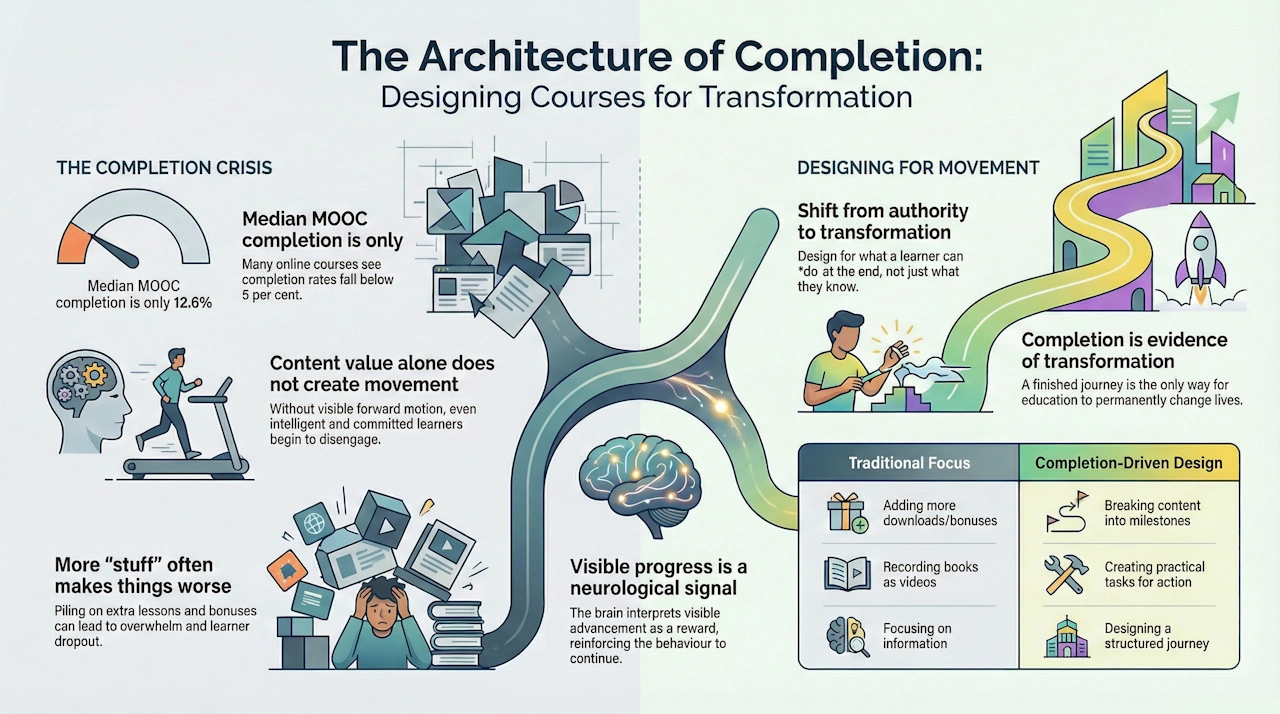
Massive Open Online Courses (MOOCs) have received significant global attention but face substantial criticism for their low completion rates on mainstream platforms. PLOS reports median MOOC completion rates of approximately 12.6%. Other studies place many courses below 10 per cent, with some falling under 5 per cent.
When Knowledge Is Delivered but Progress Is Not Designed
Most online courses are constructed around content. The assumption is that if the material is valuable enough, learners will stay.
But value alone does not create movement.
A course must carry someone from one state to another. Without visible forward motion, even intelligent learners begin to disengage.
Momentum dissolves when progress cannot be seen.
The Psychology of Staying
Research highlights three engagement dimensions: behavioural participation, emotional investment, and cognitive effort.
Gamification, when aligned with real learning objectives, improves completion by making progress visible.
Learners persist when advancement is visible and sequenced.
How the Brain Decides Whether to Continue
When learners begin a course, they are motivated by a goal. But motivation is not a fixed personality trait — it is a response to perceived progress. Human psychology is reward-sensitive. When effort produces visible advancement, the brain registers movement toward completion and reinforces behaviour. When effort feels repetitive, unclear, or endless, that reinforcement weakens. The brain interprets the task as high effort with uncertain reward. And when reward feels uncertain, avoidance begins.
This is why visible sequencing, milestones, and structured progression are not cosmetic features. They are neurological signals. They tell the learner: “You are moving.” Without those signals, even capable, committed people quietly disengage.
Why Adding More Often Makes It Worse
When fewer students finish a course, many creators respond by adding more stuff. More lessons. More downloads. More bonuses.
But piling on extra material can actually make things harder. When people feel overwhelmed, they slow down or stop.
The best courses don’t start with “What else can I add?”
They start with “What should someone be able to do at the end?”
Then they build the course step by step, making it a little more advanced over time, and they make sure students can see their progress along the way.
People don’t finish by accident.
They finish when the course is carefully and deliberately built.
From Authority to Transformation
A book proves you know your subject.
A course has to help someone actually do something with that knowledge.
Simply recording your chapters or turning them into videos doesn’t automatically help people move forward. Ideas on their own aren’t enough. They need to be turned into clear steps, practical tasks, and a structured journey.
That’s the kind of work we focus on at 'The Customer’s Shoes', turning expertise into an experience that creates real progress.
We work with authors and experts around the world who don’t just want to turn their book into a set of videos.
They want something that actually helps people finish and get results.
What we do is take their ideas and turn them into a clear step-by-step journey. We break the content into meaningful milestones. We design practical tasks that get learners taking action. We build in checkpoints that keep people motivated when they’re most likely to drop off.
And we make sure the course isn’t just impactful, it also makes commercial sense and supports long-term growth.
The Question That Changes the Conversation
If learners are not finishing, the issue is rarely ambition.
The real question is whether the experience was designed to carry them through.
Completion is not a vanity metric. It is evidence of transformation.
When students finish, they change.
And when they change, your work becomes more than information. It becomes legacy.
Design the Path They’ll Actually Finish
At its best, education quietly and permanently changes lives. But change only happens when learners reach the end of the journey you have designed for them. If they are drifting before they arrive, the answer is not to question their commitment, but to strengthen the path beneath their feet.
Build for completion. Design for movement. Create experiences that hold people until transformation takes root. Because when students finish, something shifts, not only in them, but in the legacy of the work you leave behind.
If you are ready to design a course that students can complete, particularly if you are translating a book or body of intellectual work into a learning experience, we would be delighted to begin that conversation with you.
Explore how we architect completion-driven, transformation-focused online courses here:
Or reach out directly to discuss how your expertise can become a structured learning journey that guides your audience to meaningful change.
Schedule a Free Discovery Call
Are you looking for support in planning, designing, creating, publishing or promoting your online courses? Schedule a call and let's explore how we can help you.
GET KAJABI FREE FOR 30 DAYS
Try Kajabi for 30 days for free.
Stay connected with news and updates!


Get Kajabi Services
We’re Certified Kajabi Experts with 16 years of hands-on Kajabi experience and 25 years of instructional design expertise, combining platform mastery with powerful learning strategies to build online course businesses that truly thrive.
From big-picture growth strategy to fully “Done-For-You” implementation, we manage every detail with precision—so you can stay focused on serving your audience. We don’t just build courses; we design transformative learning experiences that convert, engage, and retain.
Our mission is simple: unlock the full potential of your Kajabi account, maximise your ROI, and create programs your students love, and keep coming back for.


50% Complete
Add Your Details
Add your details and we will email you helpful advice and insights. You can unsubscribe at any time.