Before You Spend Six Months Creating Something New, Open That Embarrassing Folder on Your Computer.

Have you ever wondered whether the next thing you should be selling is something you’ve been using for years, while everyone else is busy telling you to create another course?
There’s something about the way we’re encouraged to grow our businesses that I find increasingly frustrating. Everywhere you look, somebody seems to be explaining why you need another income stream, a digital product, an online course, or a completely new offering that will somehow free you from spending your days working with clients.
It all sounds appealing, especially when you’ve spent years building a business around your expertise, and you’re beginning to wonder whether you really want to be personally involved in every engagement for the next twenty years. But I do wonder how many experienced professionals are being encouraged to invest time and money in creating something new when they’ve never properly examined the commercial value of what they’ve already developed.
If you’ve been running a specialist business for any length of time, I suspect your computer contains a rather impressive collection of documents that nobody outside your business has ever seen.
There will be client presentations, questionnaires, training resources, assessment frameworks, templates and probably several files with names like FINAL, FINAL UPDATED and FINAL VERSION 3, which made perfect sense at the time but are now almost impossible to distinguish. Some of these resources were created to solve a particular client problem, while others have been refined over years of practical experience and have gradually become part of the way you work. And because you’ve been using them for so long, you probably don’t give them a second thought, even though some may contain the very knowledge that makes your expertise valuable.
Fifteen Years of Experience, Six Months of Course Creation and a Rather Uncomfortable Silence
Imagine an experienced HR consultant, let's call her Sabrina. She's spent fifteen years helping growing businesses deal with the problems that arise when the organisation becomes too large to operate through informal conversations and the founder’s personal involvement in everything.
Sabrina's particularly good at recognising that awkward stage where the business has grown from a handful of employees to forty or fifty people, but the management structure hasn’t really caught up. Decisions are still being made by whoever happens to be available, managers are unsure where their responsibilities begin and end, and the founder is becoming increasingly frustrated because everybody seems to need their approval before anything can move forward.
She’s seen these situations so often that she’s developed a reliable approach to identifying what’s happening, using questionnaires, management assessments and structured conversations that help her understand where the real problems lie.
Over the years, Sabrina has created an extensive collection of resources that support this work, refining them through experience rather than developing them in theory. She knows which questions uncover issues founders don’t always recognise, which management problems are likely to worsen as the business grows, and which changes are practical for an organisation without the resources of a large corporation.
Her clients value her judgement, she has a good reputation, and the consultancy provides a reasonable income, but she’s becoming increasingly aware that almost everything depends on her personal involvement. So when she starts hearing about opportunities to generate revenue from online education, it seems entirely sensible to turn her experience into a course for founders struggling to manage growing teams.
Sabrina spends months planning the content, recording lessons, preparing worksheets and making sure everything looks professional, because if she’s going to put her name to something, it's to be good. Eventually, the course is ready, the website is live, and she’s excited to have created something people can purchase without her personal involvement. Unfortunately, the response is disappointing, and after all that work she’s left wondering whether the problem is the marketing, the price or perhaps the platform she’s chosen.
This is an illustrative scenario rather than an actual client case, but it raises a question I think deserves far more attention than it gets.
How can someone have years of proven expertise, a methodology that works, and resources clients genuinely value, yet still create an offering that hardly anybody wants to buy?
Your Customers Probably Don’t Want to Become Experts in Your Subject
The answer may be uncomfortable, particularly for those of us who’ve spent years becoming knowledgeable about something, because it’s easy to assume others will recognise the value of what we know in much the same way we do.
Our consultant Sabrina understands organisational development, management responsibilities, and the importance of having the right processes in place, so she naturally believes founders would benefit from learning those things. And she’s probably right, but that doesn’t necessarily mean they want to spend several weeks studying the subject, particularly when they’re already trying to run a business that’s becoming increasingly difficult to manage.
If she looked back through her previous client engagements, she might discover that very few founders originally approached her because they wanted to improve their understanding of organisational management. They contacted her because their managers were arguing, good employees were leaving, decisions were taking too long, and they couldn’t understand why a business that had previously been enjoyable to run was becoming such hard work. They wanted somebody to identify what was going wrong and help them do something about it, preferably before the situation became any more expensive or frustrating. Yet the course she’d created was built around everything she believed they ought to know, which isn’t necessarily the same thing as providing the solution they were looking for.
I think this is where experienced professionals can inadvertently make life difficult for themselves, because once you’ve developed a considerable amount of expertise, it’s tempting to start with everything you could teach rather than the particular problem somebody would pay to have solved.
And if you start with the wrong question, you can spend months creating something genuinely useful, beautifully presented, and commercially disappointing.
The Most Interesting Part of Her Business Wasn’t the Course at All
Suppose Sabrina went back through the work she’d completed over the previous five years and started examining what actually happened at the beginning of each engagement. She might notice that although clients arrived describing different problems, she regularly followed the same process to establish what was really happening within their organisations.
She had developed particular questions that helped her identify confusion about responsibilities, recognise weaknesses in management capability and understand why decisions were becoming stuck. That approach had been tested repeatedly, refined through experience and supported by resources she’d already created, yet she’d never really considered whether it might have commercial value independently of the larger consulting engagements in which she used it.
Now that interests me considerably more than the idea of creating another course, because perhaps the opportunity wasn’t to teach founders everything she knew about managing people. Perhaps there was a market for a focused assessment that helped them understand where their growing business was becoming vulnerable, or a structured improvement programme that addressed the particular problems her diagnostic process consistently uncovered.
There might even be potential for other HR professionals to learn and deliver the methodology, although that would introduce questions about training, quality control and whether the approach could produce reliable outcomes without her personal involvement. Equally, she might discover that the most commercially sensible option was to use those resources to improve the efficiency and profitability of her existing consultancy rather than create a separate product.
We wouldn’t know which option made sense until we’d investigated the demand, the customers, the delivery requirements and the financial implications, but at least she’d be examining opportunities that had emerged from real client problems rather than deciding on a product format and hoping to find customers afterwards.
Before You Create Another Product, Have a Look at What People Have Already Paid You to Solve
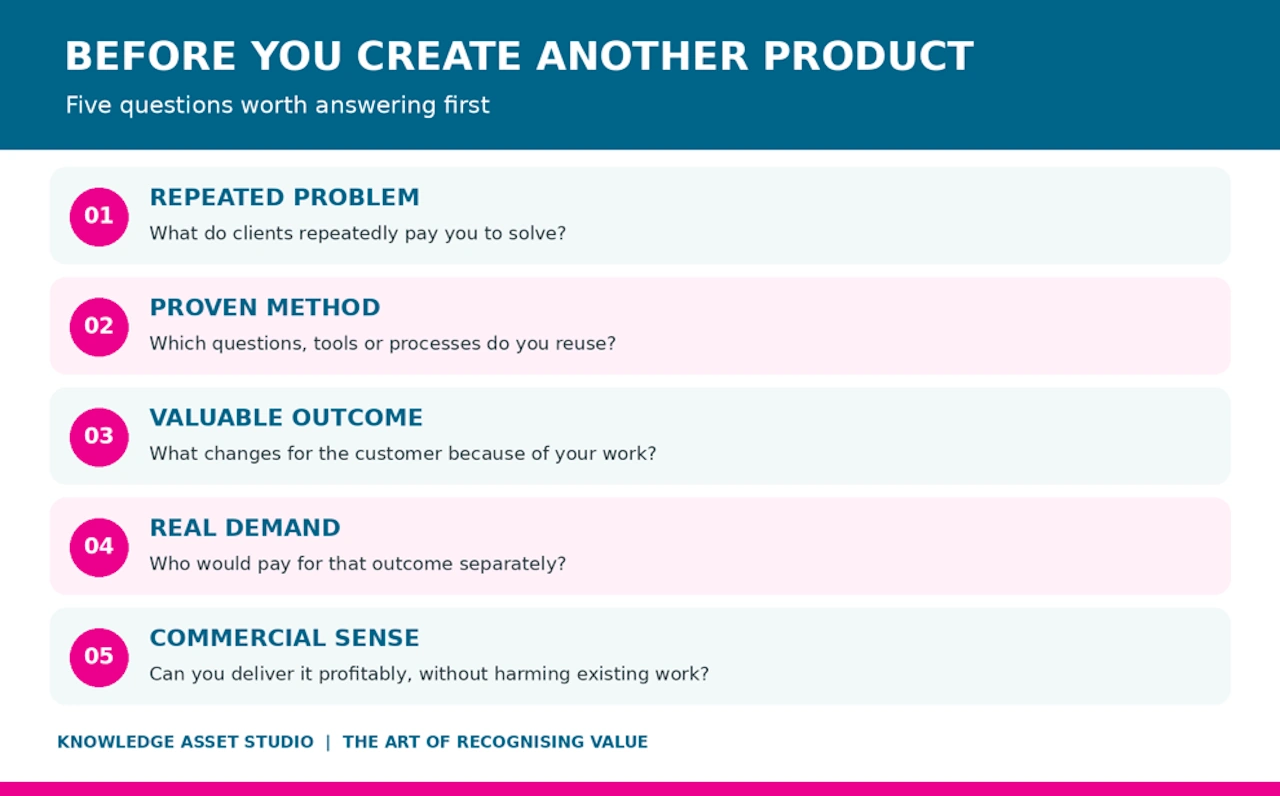
If this has you thinking about your own business, I wouldn’t suggest spending the weekend going through every folder you’ve created since you started trading, because it's a depressing prospect and probably won’t tell you much about where the commercial opportunities lie. I’d start by choosing five recent client engagements and looking at the problems those clients originally asked you to solve, then comparing them with what you discovered once you began working together.
You may find that apparently different problems had remarkably similar underlying causes, or that you repeatedly used the same questions, assessments or frameworks to understand what was happening.
I’d pay particular attention to the moments when your experience made the biggest difference, especially where you recognised something the client hadn’t noticed or helped them reach a decision they were struggling to make. Perhaps you’ve developed a process for identifying operational weaknesses, a framework for evaluating difficult decisions or a structured approach to solving a problem that appears repeatedly across different clients. If you can identify something that consistently helps produce a valuable outcome, it’s worth asking whether that part of your expertise could be useful beyond the complete service you currently deliver.
But I wouldn’t start designing a product just yet, because the next question is whether customers would recognise enough value in that outcome to pay for it independently. A resource that works brilliantly as part of a £10,000 consulting engagement doesn’t automatically become something people will buy for £500, and a methodology that relies heavily on your personal judgement may be hard to deliver profitably in another format. Those are the sorts of things I’d want to establish before anybody starts investing in websites, technology or beautifully designed workbooks.
Please Don’t Turn Every Spreadsheet Into a Business Opportunity
There’s a danger that once people start looking at their existing knowledge as a potential commercial asset, they become rather enthusiastic about everything they’ve created, and I can understand why.
After all, those resources represent years of work, and some may genuinely have considerable value, but that doesn’t mean customers will necessarily want to buy them. A checklist that helps you deliver excellent service might be almost useless to someone who doesn’t have the experience to interpret it, while a training resource developed for one organisation may need substantial refinement before it's suitable for a wider audience.
I also wouldn’t encourage someone to abandon a profitable service business simply because they’ve been persuaded that selling digital products is a more sophisticated way of earning money. There are perfectly good reasons to keep delivering premium services, particularly when customers value your judgement and are willing to pay well for it; sometimes the best commercial opportunity is making that business more efficient or enabling others to deliver parts of your methodology.
I’d be equally cautious about developing a lower-priced assessment if it required almost as much of your personal time as a full consulting engagement, or if it simply encouraged existing customers to purchase something cheaper instead of the service they previously valued.
None of these considerations means the opportunity should be dismissed, but they do mean it deserves proper investigation before you become too attached to the idea.
The Rather Unfashionable Business Advice That Might Save You a Fortune
Before developing anything, I’d want to understand whether the problem matters enough to a clearly defined group of customers, whether those customers recognise the need for a solution and whether they’d be prepared to pay for the outcome. I’d also want to examine the alternatives already available, the work involved in delivering the offering, and whether it could generate a worthwhile return without unnecessarily complicating the business.
These aren’t particularly glamorous questions, and I doubt they’ll ever attract quite as much attention as promises of passive income, but they can make the difference between developing something commercially worthwhile and spending months creating another product that never really finds its market.
Research into new product performance has highlighted the importance of meeting customer needs and offering a meaningful advantage over alternatives, which is worth remembering when you’re considering how to commercialise your expertise. Having something useful is a good starting point, but understanding who values it, why they would buy it and whether the economics work is what turns an interesting possibility into a credible commercial opportunity.
Personally, I’d much rather discover during a commercial assessment that an idea isn’t worth developing than find out after somebody has spent six months and a considerable amount of money bringing it to market.
Perhaps Your Next Big Idea Isn’t New at All
We’re constantly encouraged to think about what’s next in business, and there’s nothing wrong with exploring new opportunities, but I wonder how often we overlook what we’ve already developed because we’re so accustomed to using it. If you’ve spent years helping clients solve difficult problems, you’ve probably created knowledge, methods and resources that have been tested in real situations and refined through experience, and some of those things may deserve more commercial attention than they’ve received.
You may discover that the best decision is to continue using them within your existing services, or you might identify the foundations of an assessment, a structured programme or a methodology that could eventually be delivered by other people.
Some ideas won’t stand up to scrutiny, and that’s useful to know too, because deciding what not to develop can be just as valuable as identifying what deserves investment.
Something Worth Considering
If I asked you to look back over the past five or ten years, which problems have your clients repeatedly paid you to solve, and what have you developed to solve them? Perhaps it’s a questionnaire, a particular way of diagnosing a situation or a process you’ve refined so many times that you hardly notice you’re using it anymore. Have you ever considered whether that knowledge could have commercial value independently of the service you currently provide, or have you simply become so used to it that you no longer recognise what you’ve created?
It might be worth opening a few of those old folders before you spend another six months inventing something completely new.
At The Customer's Shoes, we help experienced professionals and specialist businesses investigate the commercial potential of the knowledge, methodologies and resources they’ve already developed, so they can make informed decisions about what deserves further investment.
If this has made you curious about what might already exist within your business, you’re welcome to get in touch.
Schedule a Free Discovery Call
Are you looking for support in planning, designing, creating, publishing or promoting your online courses? Schedule a call and let's explore how we can help you.
GET KAJABI FREE FOR 30 DAYS
Try Kajabi for 30 days for free.
Stay connected with news and updates!


Get Kajabi Services
We’re Certified Kajabi Experts with 16 years of hands-on Kajabi experience and 25 years of instructional design expertise, combining platform mastery with powerful learning strategies to build online course businesses that truly thrive.
From big-picture growth strategy to fully “Done-For-You” implementation, we manage every detail with precision—so you can stay focused on serving your audience. We don’t just build courses; we design transformative learning experiences that convert, engage, and retain.
Our mission is simple: unlock the full potential of your Kajabi account, maximise your ROI, and create programs your students love, and keep coming back for.


50% Complete
Add Your Details
Add your details and we will email you helpful advice and insights. You can unsubscribe at any time.